
We often conflate conflict with disagreement.
Oftentimes it was two people solving different problems and not knowing it. Alignment isn’t about getting everyone to agree: it’s about getting everyone to see the same problem first.
Par Maëlle Costa · 4 août 2026
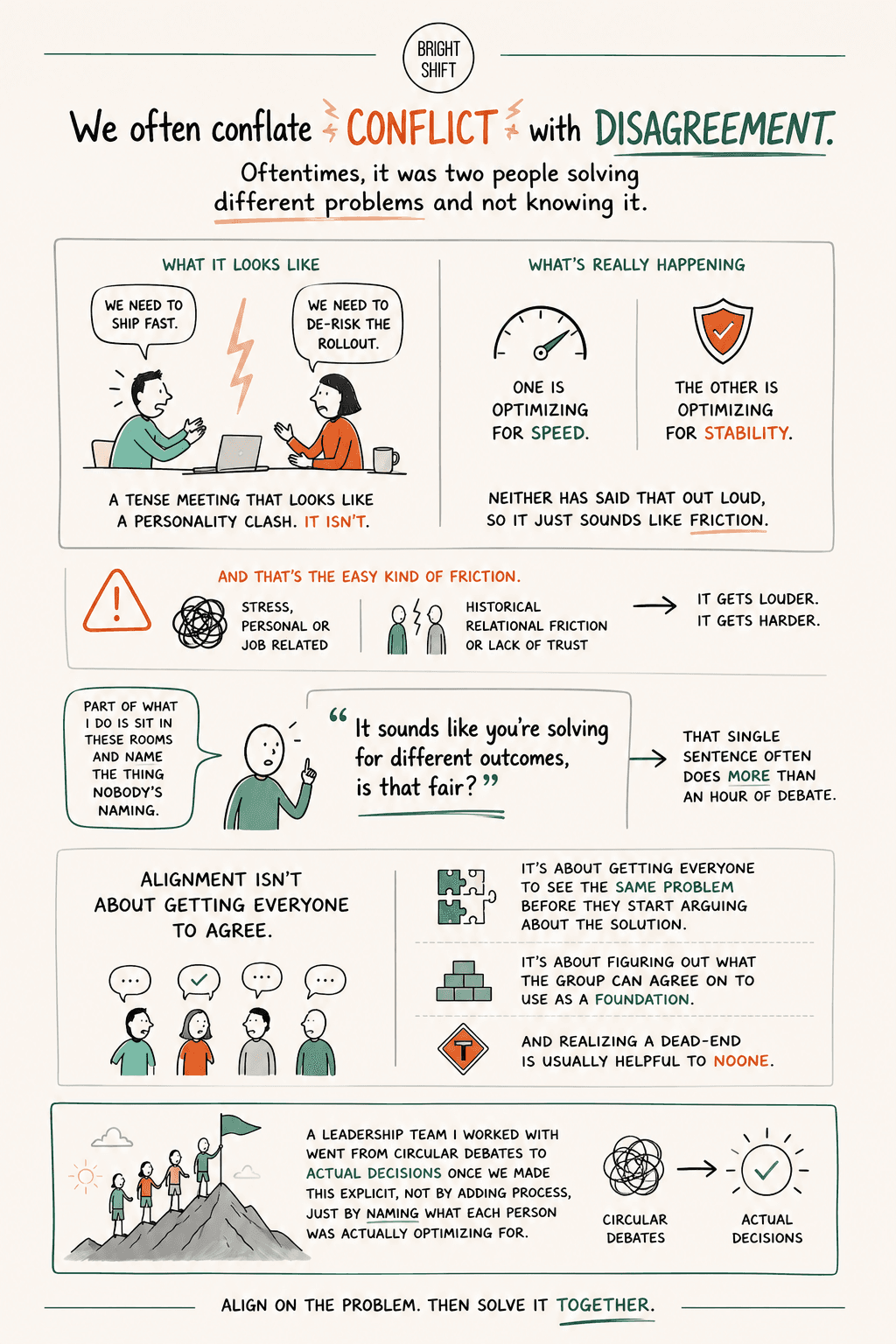
We often conflate conflict with disagreement. Oftentimes, it was two people solving different problems and not knowing it.
A head of product wants to ship fast. A head of ops wants to de-risk the rollout. They end up in a tense meeting that looks like a personality clash. It isn’t. One is optimizing for speed. The other is optimizing for stability. Neither has said that out loud, so it just sounds like friction.
And that’s the easy kind of friction. Add in layers of stress, personal or job-related. Add in historical relational friction or lack of trust.
Part of what I do is sit in these rooms and name the thing nobody’s naming: “it sounds like you’re solving for different outcomes, is that fair?”
That single sentence often does more than an hour of debate.
Alignment isn’t about getting everyone to agree.
- It’s about getting everyone to see the same problem before they start arguing about the solution.
- It’s about figuring out what the group can agree on to use as a foundation.
- And realizing a dead-end is usually helpful to no one.
A leadership team I worked with went from circular debates to actual decisions once we made this explicit, not by adding process, just by naming what each person was actually optimizing for.